


Statutory Information

Contact details, including:
- your school’s name
- your school’s postal address
- your school’s telephone number
- the name of the member of staff who deals with queries from parents and other members of the public
- the name and contact details of your special educational needs co-ordinator (SENCO)

You can contact us at:
Sacred Heart R.C. Primary School & Teach Heart Alliance
Central Drive
Westhoughton
Bolton
BL5 3DU
Tel: 01942 634681
Address all enquiries to the School Business Manager, Mrs J Altham
SENCOs: Mr Mike Stubbs | Miss M Fairhurst
For more information, go to ‘Contact Us‘.
Admission arrangements, including:
- The school’s consideration process for every age group.
- Selection arrangements.
- Any oversubscription criteria.
- How to apply for a place, for each year group, or a link / directions to where they can be found.

The Admissions Policy outlines our procedures for allocation of places, including oversubscription criteria.
For all cohorts, since 2012, our admission number is 60.
Bolton L.A. co-ordinate our admissions on behalf of the Governing Board, who are the admissions authority. It is advisable for prospective parents / carers to contact the school to arrange a visit prior to application. Further details of how to apply for a school place, or instigate the appeals process can be found on the Bolton website.
For more information, visit our Admissions Arrangements page.
School Uniform:
The department produces statutory guidance on the cost of school uniforms which schools must have regard to when developing and implementing their school uniform policy. This guidance requires schools to publish their uniform policy on their website.
The published uniform policy should be easy to understand and, where a school has a school uniform, should:
- clearly state whether an item is optional or required
- make clear if the item will only be worn at certain times of the year (for example, if it’s summer or winter uniform)
- make clear whether a generic item will be accepted or if a branded item is required
- make clear whether an item can only be purchased from a specific retailer or if it can be purchased more widely, including from second-hand retailers

Details of or a link to, the school’s most recent Ofsted report.

Download our latest Ofsted reports:
or by following the link to the Ofsted website.
To read our Section 48 Catholic School Inspection report (July 2025) click here
Test, exam and assessment results:
The school’s most recent Key Stage 2 (KS2) end of primary results under the following headings:
- Percentage of pupils achieving the expected standard or above in reading, writing and maths.
- The average progress in reading, writing and maths.
- Percentage of pupils achieving an average ‘scaled score’ in reading and maths.
- Percentage of pupils who achieved a high level of attainment in reading, writing and maths.
You do not need to publish your key stage 2 results for the academic year 2021 to 2022 on your website, as the Secretary of State will not publish this data. This is because statutory assessments returned for the first time since 2019, without adaptations, after disruption caused by the pandemic.
You should continue to display your school’s most recent key stage 2 performance measures, as published by the Secretary of State, on your website. For most schools, these will be the performance measures published for the 2018 to 2019 academic year.
You should clearly mark that these performance measures are for the 2018 to 2019 academic year and are not current. For example, you could add the following to your results:
“The government will not publish KS2 school level data for the 2021 to 2022 academic year. The last available public data is from the 2018 to 2019 academic year. It is important to note that the data from that year may no longer reflect current performance.”

Performance measures website:
You must include a link to the school and college performance measures website and your school’s performance measures page.
School Opening Hours:
Schools should publish on their website their opening and closing times and the total time this amounts to in a typical week (for example 32.5 hours).
Schools should show the compulsory times they are open. This time runs from the official start of the school day (morning registration) to the official end of the compulsory school day. It includes breaks, but not optional before or after school activities.
Visit the school session times page of our Virtual Office.
School day: 8:55am-3:35pm
Total time in a typical week: 33h 20min.
Curriculum:
- the content of your school curriculum in each academic year for every subject – this includes mandatory subjects such as religious education, even if it is taught as part of another subject or subjects, or is called something else
- the names of any phonics or reading schemes you’re using in key stage 1
- how parents or other members of the public can find out more about the curriculum your school is following
You must also set out how over time you will increase the extent to which disabled pupils participate in the school’s curriculum, as part of your school’s accessibility plan.

We follow the Essential Letters & Sounds synthetic phonics approach to phonics teaching…
We have a range of fully decodable books.
For handwriting, we follow the Letter-join scheme of work.
To access additional information:
If your child is already at our school, please, in the first instance, contact their teacher(s), before contacting the Senior Pastoral Lead / Deputy Headteacher.
If your child is not at the school, and you want to find out more, please contact the School Business Manager Mrs J Altham.
Alternatively, if you wish to learn more about curriculum map, or find out more about our curriculum approach follow the links, or contact us…
Pupils with Education Health & Care Plans, or disability which may lead to a EHCP, have individual details in their EHCP of the extent to which they participate in the full curriculum. Interventions are not designed to limit the breadth of curriculum for pupils. Our Accessibility plan can be found on the policy page of the Virtual Office.
Remote education:
You should consider publishing information about your school’s remote education provision on your website.
Full details of our remote education provision can be found in the Curriculum section of our website.
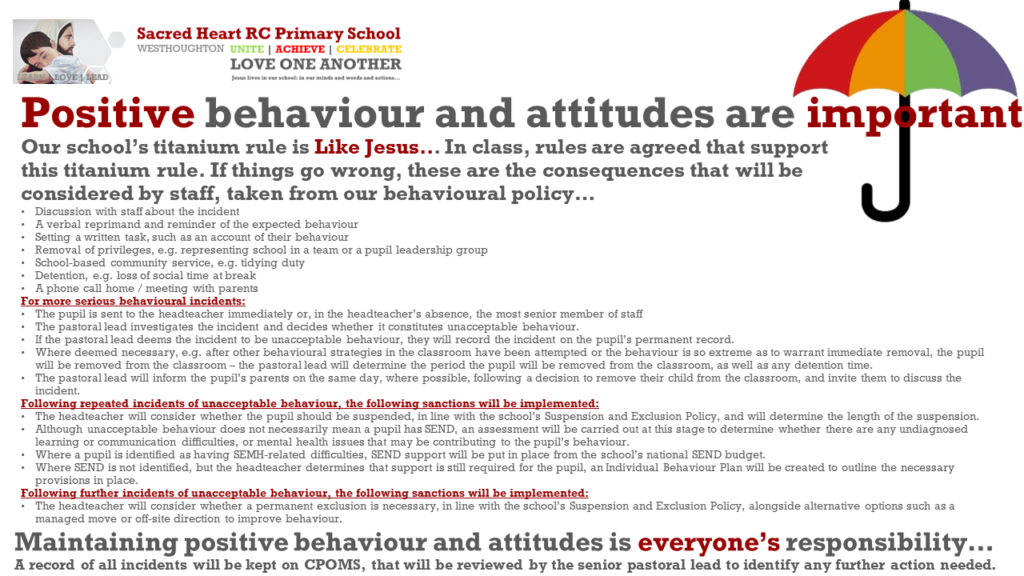
Behaviour Policy:
The school’s Behavioural Policy, including details of how it complies with section 89 of the Education and Inspections Act 2006.

Click here for our current Behavioural Policy
Fully compliant with the Act, s89 as at:
http://www.legislation.gov.uk/ukpga/2006/40/part/7
Adult Behaviour Policy
Appendix – signage
Alternatively, visit our ‘School Policies‘ page.
Pupil Premium & Recovery Premium:
All schools that receive pupil premium funding must publish a pupil premium strategy statement each year by 31 December.
In the strategy statement, you must explain how your pupil premium and recovery premium is being spent and the outcomes that are being achieved for pupils. It’s important that parents and governors understand this, and you should write it with them in mind.
You must use the DfE template to produce your statement. This can be found alongside completed examples and guidance for school leaders on the pupil premium guidance page.
The template has been designed to ensure that your statement reflects the requirements in the pupil premium conditions of grant. This includes a requirement for pupil premium and recovery premium to be spent in line with the department’s ‘menu of approaches’ from the start of the 2022 to 2023 academic year. The menu can be found in the document ‘Using pupil premium: guidance for school leaders’, on the pupil premium guidance page.
We recommend that you plan your pupil premium use over 3 years. If you do so, you are still required to update your statement each year to reflect your spending activity for that academic year and the impact of pupil premium in the previous academic year.

Pupil Premium Reports are available on our Pupil Premium Grant page.
Allocations summary:
- 2011-2012: £6,382
- 2012-2013: £15, 557 (£623/pupil)
- 2013-2014: £33,355 (£953/pupil)
- 2014-2015: £40,300 (£1,300/pupil) + £5,700 (Post CLA: £1,900/pupil)
- 2015-2016: £38,600 (£1,320/pupil) + £5,700 (Post CLA: £1,900/pupil)
- 2016-2017: £46,200
- 2017-2018: £52,640
- 2018-2019: £43,560 + £6,900 ( Post CLA: £2,300/pupil)
- 2019-2020: £38,260 + £6.900 ( Post CLA: £2,300/pupil)
- 2020-2021: £46,000
- 2021-2022: £46,040
- 2022-2023: £51,550
- 2023-2024: £63,215
- 2024-2025: £54,760 (£7,710 LAC | £1020 SC)
- 2025-2026: £51,510 (£5,260 LAC | £700 SC)
- Focused intervention teacher [ongoing];
- Closing the gap teacher [2015-2016 academic year];
- TA2+SNA employed to work with non-EHC plan children;
- Additional intervention support from apprentice learning support staff within KS1 & KS2 [Au213 – ongoing];
- Outdoor Learning groups focusing on the spoken word and communication – staffing & resource costs. [oLé / workshop] [Autumn 2011 – ongoing];
- Art Academy /oLé learning groups focusing on achievement and communication [Autumn 2014 – ongoing];
- SEAL intervention groups – one afternoon (when needed) / week [ongoing];
- Additional teacher to enable SENCo to be non-class-based [Autumn 2013 – ongoing];
- Room2Grow & be… lunchtimes focusing on communication – staffing & resource costs;
- TA1 runs A.R.R.O.W. intervention programme;
- Support small groups & booster / masterclass group costs within Y6;
- Specific curriculum resources – e.g. Toe By Toe / Sign-along dictionary / iPad;
- Contribution towards additional ICT / book / outdoor learning resources – e.g. green screen technology / reading scheme top up / fire & shelter building materials;
- Run UFA Sunflower Club – [periodically];
- Contribution to educational visits / residential visits etc.
- Natures Den Forest School Courses [periodically].
IMPACT: This is measured via half termly Triangulation and Pupil Progress meetings, and in meetings with the SENCo where all of the above interventions are allocated and impact reviewed on the provision map. All have had a significant contribution to advancing the achievement of pupils – which is exemplified in the attached reports.
Recovery Premium & Coronavirus (COVID-19) catch-up premium grant in academic year 2020 to 2021:
- how it is intended that the grant will be spent
- how the effect of this expenditure on the educational attainment of those pupils at the school will be assessed
Read further information on the coronavirus (COVID-19) catch-up premium.
Recovery premium reports:
2021-2022 | £18,347
2022-2023
£4,640 + School led tutoring 2022-2023 – £3,041 Total = £7,681
2023-2024
£3,741 + School led tutoring 2023-2024 – £5,075 Total = £8,816
PE and sport premium:
If your school receives PE and sport premium funding, you must publish:
- the amount of premium received
- a full breakdown of how it has been spent (or will be spent)
- what impact the school has seen on pupils’ PE and sport participation and attainment
- how the improvements will be sustainable in the future
You are also required to publish the percentage of pupils within your year 6 cohort who met the national curriculum requirement to:
- swim competently, confidently, and proficiently over a distance of at least 25 metres
- use a range of strokes effectively (for example front crawl, backstroke, and breaststroke)
- perform safe self-rescue in different water-based situations
You must publish all the information in this section by the end of the summer term, or 31 July at the latest. This is outlined in the conditions of grant document.
To help plan, monitor and report on the impact of your spending, partners in the physical education and school sport sector have developed a template. The template can be accessed through the Association for PE and Youth Sport Trust websites.

P.E. & Sports Premium Reports: All reports can be found at https://www.sacred-heart.bolton.sch.uk/pe-and-sport-premium-grant/
Allocations summary:
- 2013-2014: £5,823
- 2014-2015: £9,490
- 2015-2016: £9,490
- 2016-2017: £9,637
- 2017-2018 – £19,760
- 2018-2019 – £19,459
- 2019-2020 – £19,481
- 2020-2021 – £16,000
- 2021-2022 – £19,550
- 2022-2023 – £19,510
- 2023-2024 – £19,570
- 2024-2025 – £19,610
- 2025-2026 – £17,955
More information is on the P.E. & Sport Premium Reports page on this website.
Public Sector Equality Duty
The Equality Act 2010: advice for schools outlines how your school can demonstrate compliance with the public sector equality duty – for example, including details of how your school is:
- eliminating unlawful discrimination, harassment and victimisation and other conduct prohibited under the Equality Act 2010
- advancing equality of opportunity – between people who share a protected characteristic and people who do not
- fostering good relations between people who share a protected characteristic and those who do not
- consulting and involving those affected by inequality, in the decisions your school takes to promote equality and eliminate discrimination – affected people could include parents, pupils, staff and members of the local community
As public bodies, local authority-maintained schools must comply with the public sector equality duty in the Equality Act 2010 and the Equality Act 2010 (Specific Duties and Public Authorities) Regulations 2017. This means you must publish:
- details of how your school complies with the public sector equality duty – you must update this every year
- your school’s equality objectives – you must update this at least once every 4 years
Details of these publishing obligations are set out in Equality Act 2010: advice for schools

Our Equality Scheme & Accessibility Plan are located on the Information for Parents & SEND page of this website.
Special educational needs and disability (SEND) information:
You must publish an information report on your website about the implementation of your school’s policy for pupils with SEN. You should update the report at least annually.
You should update any changes occurring during the year as soon as possible. The report must comply with section 69 of the Children and Families Act 2014, meaning that it must contain:
- the ‘SEN information’ specified in schedule 1 to the Special Educational Needs and Disability Regulations 2014. Statutory guidance on this is contained in paragraphs 6.79 to 6.82 of the special educational needs and disability code of practice: 0 to 25 years
- information on:
- the arrangements for the admission of disabled pupils
- the steps you have taken to prevent disabled pupils from being treated less favourably than other pupils
- the facilities you provide to help disabled pupils to access the school
- the plan prepared under paragraph 3 of schedule 10 to the Equality Act 2010 (accessibility plan) for:
- increasing the extent to which disabled pupils can participate in the school’s curriculum
- improving the physical environment of the school for the purpose of increasing the extent to which disabled pupils are able to take advantage of education and benefits, facilities or services provided or offered by the school
- improving the delivery to disabled pupils of information which is readily accessible to pupils who are not disabled
SEND report:
Fully compliant with legislation at:
http://www.legislation.gov.uk/ukpga/2014/6/section/69
http://www.legislation.gov.uk/uksi/2014/1530/contents/made
https://www.gov.uk/government/publications/send-code-of-practice-0-to-25
SEND Policy & School Offer [Provisions]
The admission arrangements for pupils with SEND are contained within our admissions policy. See section above, or for more information, visit our Admissions Arrangements page.
The name and contact details of the SEND coordinator:
Inclusion Leader – overall and SEND-co:
TLR2: Mr Mike Stubbs – StubbsM@sacred-heart.bolton.sch.uk & Miss M Fairhurst – FairhurstM@sacred-heart.bolton.sch.uk
Expertise & training of staff in relation to SEND:
The Inclusion leader attends LA & other briefings, and is chair of the Westhoughton Cluster 6 SENCo group.
All teaching and SEN support staff receive regular briefing and training, either internally or externally provided.
We are again working towards renewal of Inclusion Quality Mark | British Dyslexia Association Early Intervention Award Silver. Associated training linked to these have been attended by staff.
Contact details of support services – visit the Information for Parents & SEND page of this website to useful see web-links:
Bolton LA local offer – click here
Accessibility Plan – click here
Fully compliant with the Act, para 3, schedule 10 as at:
http://www.legislation.gov.uk/ukpga/2010/15/schedule/10
Complaints procedure:
You must publish details of your school’s complaints procedure, which must comply with section 29 of the Education Act 2002.
Read guidance on developing your school’s complaints procedure.
You must also publish (as part of your SEN information report) any arrangements for handling complaints from parents of children with SEN about the support the school provides.
For our complaints procedure, click here
Fully compliant with the Act:
http://www.legislation.gov.uk/ukpga/2002/32/section/29
Our complaints coordinator is currently the Executive Headteacher. Please contact by emailing office@sacred-heart.bolton.sch.uk
In the first instance, though:
- Parents / carers of children already at the school should contact their child’s teacher.
- If this doesn’t resolve the situation, contact the Phase Leader or Deputy Headteacher, before contacting the Executive Headteacher.
Anyone making a complaint who is not a parent / carer of a child at the school, should contact the School Business Manager.
Managing professional allegations: LADO linked complaints are dealt with using the first steps process outlined here…
Governors’ information and duties:
You must publish information on the governing body in line with statutory guidance on the constitution of governing bodies of maintained schools. This should include:
- details of the structure and responsibilities of the governing body and its committees
- the full names of the chair of the governing body and chair of each committee
- information about each governor, including their:
- full name, date of appointment, term of office, date they stepped down (where applicable) and who appointed them (in accordance with the governing body’s instrument of government)
- relevant business and financial interests including:
- governance roles in other educational institutions
- any material interests arising from relationships between governors or relationships between governors and school staff (including spouses, partners and close relatives)
- attendance record at governing body and committee meetings over the last academic year
You should also publish the same information for associate members making it clear whether they have voting rights on any of the committees to which they have been appointed.
Collecting and publishing governing board diversity data
Diversity is important and we want governing boards to be increasingly reflective of the communities they serve.
We encourage schools to collect and publish governing board members’ diversity data. Information should be widely accessible to members of the school community and the public. Board members can opt out of sharing their information, including protected characteristics, at any given time including after publication.
Schools must ensure that individuals cannot be identified through the publication of data, particularly when board member levels are low. Read more about this in the data protection toolkit for schools and Equality Act 2010: advice for schools.
There is no prescriptive way to collect diversity data from volunteers; this needs to be done on a voluntary basis. Schools may prefer to adopt a similar approach to how they collate the diversity data of pupils.

Please visit ‘The Governing Board’ page of this website.
Financial information:
You must publish:
- how many school employees (if any) have a gross annual salary of £100,000 or more in increments of £10,000 – we recommend using a table to display this
- a link to the webpage which is dedicated to your school on the schools financial benchmarking service – follow the prompts to find your school’s specific page
None of our employees have a gross annual salary of over £100,000.
The school’s Charging and Remissions Policy, including:
- Details of the specific situations where the school will charge parents/carers.
- The circumstances in which an exception will be made on a payment you would expect to receive under your charging policy.
Values & ethos
Your website should include a statement of your school’s ethos and values.

For more information on our Roman Catholic ethos and values, please visit the page, ‘Welcome‘ and explore the ‘About us’ section of our website.
Requests for paper copies:
If a parent requests a paper copy of the information on your school’s website, you must provide this free of charge.
Parents / carers may request a paper copy of any of the information contained on this page, at no cost.