
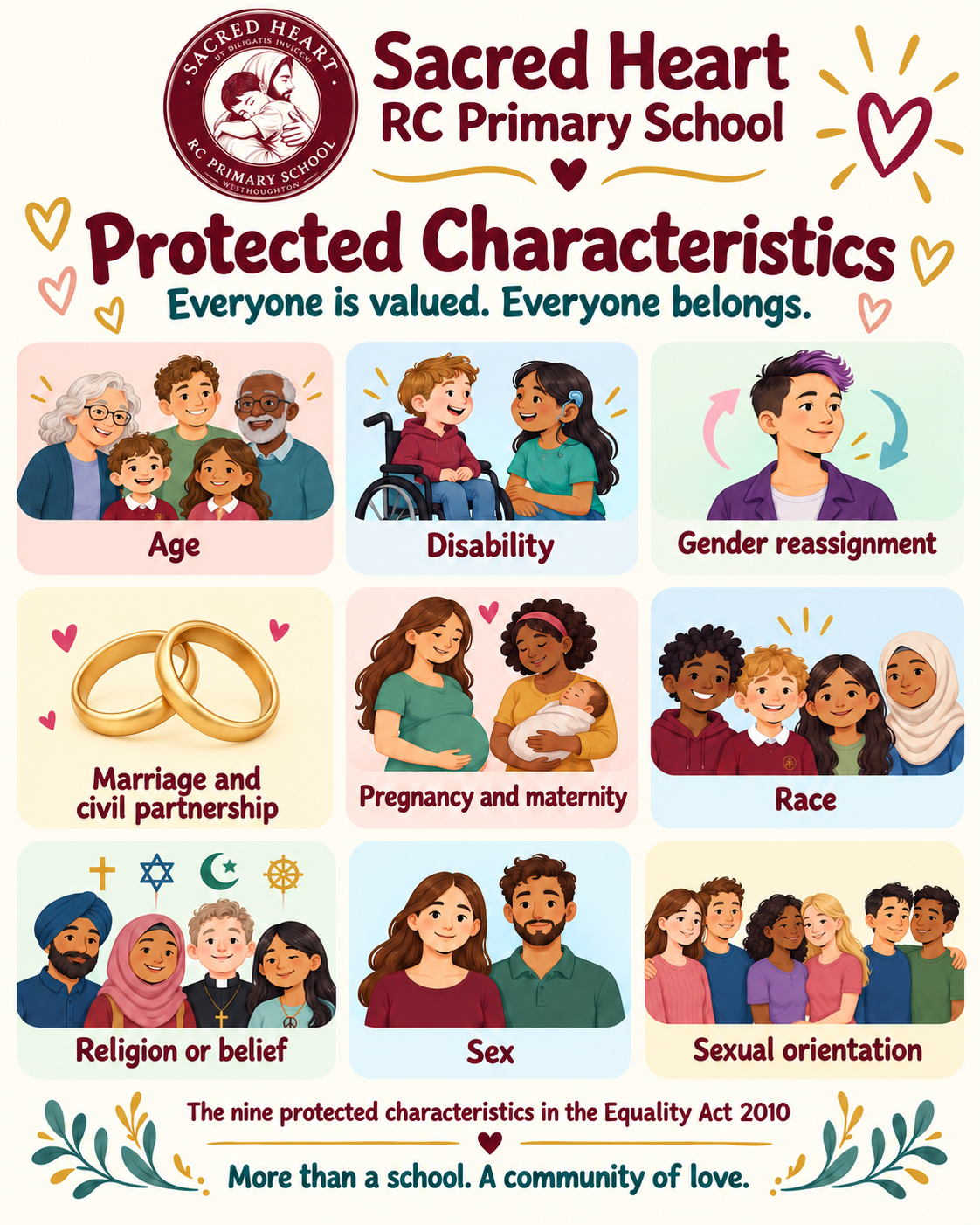
Protected Characteristics
Everyone is valued. Everyone belongs.
Love one another
At Sacred Heart, our Catholic faith teaches us that every person is made in the image and likeness of God and has inherent dignity. Our motto, Ut Diligatis Invicem — Love one another, shapes how we learn, work and live together.
We welcome children, families and staff from different backgrounds, faiths and beliefs, including those with no religious belief. We value the diversity of our community and seek to ensure that everyone is treated fairly, listened to and able to participate.
We challenge prejudice, discrimination and bullying. Respect includes listening to people whose views or experiences differ from our own, while recognising that nobody should be subjected to abuse or humiliation.
Our message to children
You matter. Other people matter too. Be kind, include others and speak to a trusted adult if someone is being treated unfairly. Nobody should be made to feel ashamed of themselves or their family.
The nine protected characteristics
The Equality Act 2010 identifies nine protected characteristics. It protects people against unlawful discrimination in settings including employment, education and services. The precise legal protection depends on the circumstances.
Age
This concerns a person’s age or age group. We encourage respect between generations and value people at every stage of life.
Disability
The Act generally defines disability as a physical or mental impairment with a substantial and long-term adverse effect on normal day-to-day activities. Some conditions receive specific protection. Disabilities may be visible or non-visible.
We work with families to identify barriers and make reasonable adjustments. Disability and special educational needs can overlap, but they are not the same.
Gender reassignment
This legal protection concerns people who propose to undergo, are undergoing or have undergone a process of reassigning their sex. Medical treatment is not required for protection.
Everyone must be treated with dignity. Individual questions and circumstances are handled sensitively, with attention to safeguarding, current guidance and children’s needs.
Marriage and civil partnership
This concerns being legally married or in a civil partnership. In England and Wales, opposite-sex and same-sex couples can marry or form a civil partnership.
No child should be treated unfairly because of their parents’ relationship or family circumstances.
Pregnancy and maternity
This provides protection relating to pregnancy and maternity, with specific rules in different settings. We encourage consideration for pregnant people, new mothers and families caring for babies.
Race
Race includes colour, nationality and ethnic or national origins. We value different languages, cultures and histories and challenge racism, racist language and racial stereotypes.
Religion or belief
This includes religion, qualifying philosophical beliefs, and having no religion or belief. Our Catholic identity is clear, and we teach respect for people of other faiths and those with no faith.
Sex
Sex is a protected characteristic concerning being male or female. We promote fairness for girls and boys, women and men, and challenge stereotypes about abilities, interests, responsibilities and future opportunities.
Sexual orientation
This concerns a person’s sexual orientation towards people of the opposite sex, the same sex or either sex. It includes heterosexual, gay, lesbian and bisexual people.
We challenge homophobic and biphobic language and bullying. Children and families must be treated respectfully, whatever their own or their family members’ sexual orientation.
How the law applies in schools
All nine characteristics are listed here to explain the wider law. Age and marriage and civil partnership are not protected characteristics under the Act’s school pupil provisions. They remain relevant in other contexts, including employment. Our expectation of dignity and respect applies to everyone.
Our curriculum and Catholic ethos
We believe that all human life is sacred and that everyone should have the opportunity to live life to the full. Children learn about dignity, fairness and respect through religious education, relationships and health education, the wider curriculum, prayer and everyday school life.
Life to the Full+
Our Life to the Full+ programme supports relationships and health education within a Catholic understanding of the human person. Its foundation is that we are created, chosen and loved by God.
Learning is adapted to children’s age, understanding and needs. Children develop confidence in friendship, kindness, personal boundaries, safety and asking for help. Teaching about the law is factual, and questions are answered sensitively.
Learning throughout school life
- Age and generations: valuing people at different stages of life and learning from the experiences of others.
- Disability and inclusion: recognising different needs, understanding barriers and appreciating people’s achievements and contributions.
- Race and culture: exploring different histories and experiences, challenging racism and learning through activities including Black History Month and Holocaust Memorial learning.
- Religion and belief: learning about Catholic faith and other religions through religious education, discussion and encounters with others.
- Families: recognising married and unmarried parents, single parents, same-sex parents, grandparents, adoptive parents, foster carers and other carers, without making children feel that their family is less valued.
- Fair opportunities: challenging assumptions about what girls and boys can achieve or which activities they should enjoy.
- Respectful relationships: practising inclusive language, listening to others, resolving disagreements and speaking up about unkindness.
We work with parents and carers and have regard to current statutory guidance. Children are not expected to disclose private information about themselves or their families. Please speak to your child’s teacher if you would like to discuss learning materials or an individual concern.
The UK Primary Schools Hub for Human Rights Education
Robert & Ethel Kennedy Human Rights Centre UK
Sacred Heart RC Primary School is the UK primary schools hub for the Robert & Ethel Kennedy Human Rights Centre UK, previously known as RFK Human Rights UK.
This role places human rights education at the heart of our school community and our work with other primary schools. It reflects our Catholic commitment to the dignity of every person and our call to love one another.
Through Speak Truth to Power, children explore human rights, fairness and the courage to challenge injustice. They learn that their voices matter and that their actions can help build kinder, fairer communities.

Our Peacemakers, Caritas Ambassadors and other pupil leaders provide opportunities to put these principles into practice: listening to others, including those who might be overlooked, serving our community and speaking up when something is wrong.
Inclusion, support and concerns
Removing barriers
Fairness sometimes means providing different support so that people can participate. Reasonable adjustments may involve communication, resources, routines or the way activities are organised.
Please tell us if a disability, health condition or communication need affects access to learning, information, meetings or school events.
SEND and accessibility informationChallenging prejudice
Racist, sexist, homophobic, biphobic, transphobic, disability-related and religion-related abuse is unacceptable, including online.
Hurtful language is addressed even when described as a joke. An incident does not need to happen repeatedly before a child or family asks for help.
Online safety informationHow to raise a concern
Children can speak to any trusted adult in school. Parents and carers should normally contact the class teacher first. Explain what happened, when and where it happened, and whether there is an immediate safety concern.
Safeguarding concerns should be brought promptly to Mrs P. Cox, Senior Pastoral Lead and Designated Safeguarding Lead, through the school office.
Concerns about a member of staff should be raised with the Executive Headteacher. For concerns about the Executive Headteacher, follow the route to the Chair of Governors in the school’s safeguarding or complaints procedure.
We will listen, consider immediate support and respond through the relevant school procedures. Confidentiality may limit what we can share about other children or adults. Please tell us if a problem continues.
Our public sector equality duty
In making decisions, we must have due regard to eliminating unlawful discrimination, advancing equality of opportunity and building good relations between people who share a relevant protected characteristic and those who do not.
Evidence can include participation in learning and activities, attendance, progress, behaviour, reported incidents and the views of pupils and families. Published information must protect people’s privacy.
Schools must update their published equality information each year and their equality objectives at least every four years. Our Equality Objectives and Annual Update is available below.
Equality Objectives and Annual Update
Our Equality Objectives and Annual Update brings together our school’s equality objectives and annual information about its work to promote equality and inclusion.
Equality Objectives and Annual Update 2026
Read the document alongside the information on this page and our related school policies.
Please contact the school office if you need a paper copy or an alternative accessible format.
Government information and guidance
- GOV.UK: discrimination and your rights
- DfE: Equality Act 2010 advice for schools
- DfE: preventing and tackling bullying
- DfE: relationships and health education guidance
- DfE: school website publication requirements
Please contact the school office if you need help accessing this information.
Updated October 2026. This page provides an overview; the linked guidance explains the legal requirements in detail.