

Gospel Values
More than a school. A community of love.
Following Jesus in the choices we make, the relationships we build and the way we serve.
Learning to live like Jesus
The values which guide and inspire us in our Christian lives are those given to us in the Gospels. They are our Gospel values.
The core Gospel values, based on the Beatitudes, may be summarised as follows:

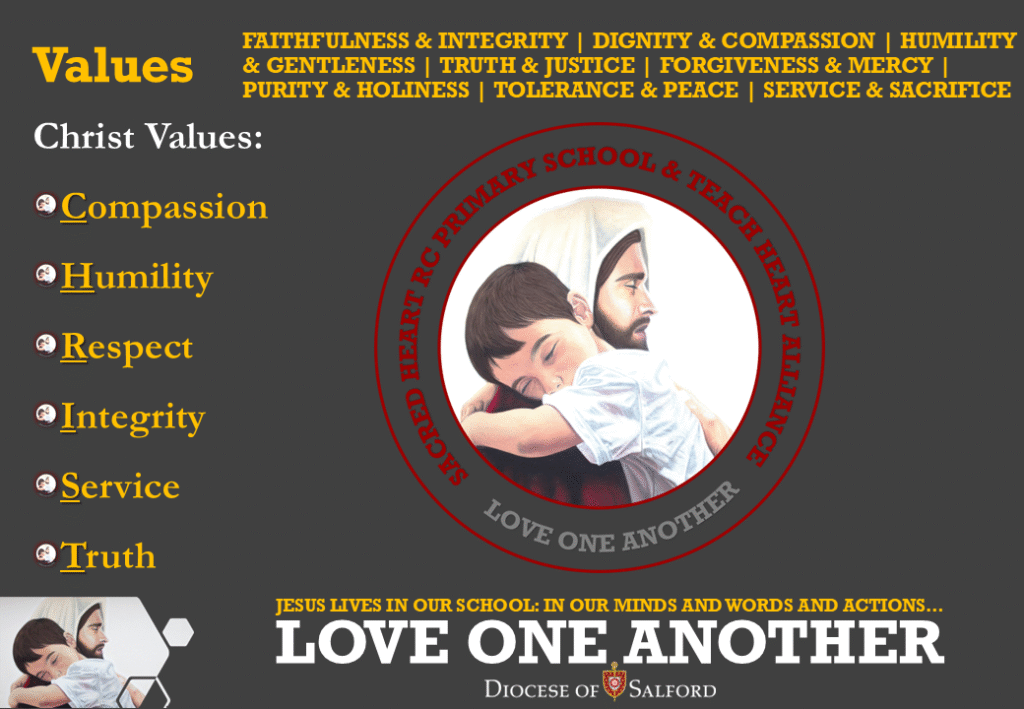

The Beatitudes: living “…like Jesus”
These statements form the blueprint for our Monday Gospel Celebrations of the Word, focusing on how we can… “…like Jesus.”
Faithfulness & Integrity
“Blessed are the poor in spirit, for theirs is the kingdom of heaven.”
Dignity & Compassion
“Blessed are those who mourn, for they shall be comforted.”
Humility & Gentleness
“Blessed are the meek, for they shall inherit the earth.”
Truth & Justice
“Blessed are those who hunger and thirst for righteousness, for they shall be satisfied.”
Forgiveness & Mercy
“Blessed are the merciful, for they shall obtain mercy.”
Purity & Holiness
“Blessed are the pure in heart, for they shall see God.”
Tolerance & Peace
“Blessed are the peacemakers, for they shall be called sons of God.”
Service & Sacrifice
“Blessed are those who are persecuted for righteousness’ sake, for theirs is the kingdom of heaven. Blessed are you when men revile you and persecute you and utter all kinds of evil against you falsely on my account. Rejoice and be glad, for your reward is great in heaven, for so men persecuted the prophets who were before you.”
Matthew 5:3–12, Revised Standard Version Catholic Edition

#FrancisFactor
Pope Francis: called to become saints
Pope Francis helped us understand how these values fit into our 21st Century lives. On the feast of All Saints, 1st November 2016, he reminded us that our aim is to be living saints.
The best description of the saints – in fact, their “identity card”, is found in the Beatitudes from Jesus’ Sermon on the Mount, which begins, “Blessed are the poor in spirit.” And as Christian saints have done throughout the ages, Christ’s followers today are called “to confront the troubles and anxieties of our age with the spirit and love of Jesus.”
New situations require new energy and a new commitment:
- Blessed are those who remain faithful while enduring evils inflicted on them by others and forgive them from their heart.
- Blessed are those who look into the eyes of the abandoned and marginalised and show them their closeness.
- Blessed are those who see God in every person and strive to make others also discover him.
- Blessed are those who protect and care for our common home.
- Blessed are those who renounce their own comfort in order to help others.
- Blessed are those who pray and work for full communion between Christians.
All these are messengers of God’s mercy and tenderness. Surely they will receive from Him their merited reward.

Putting that invitation into practice
In his All Saints homily, Pope Francis highlighted these ways of living the Beatitudes:
- Persevering in faith and forgiving those who cause us harm.
- Drawing close to people who have been left isolated or pushed to the margins.
- Recognising God’s presence in each person and helping others to recognise it too.
- Taking responsibility for the protection of our shared world.
- Giving up personal ease when another person needs our help.
- Seeking Christian unity through prayer and practical effort.
He described such people as bearers of divine compassion, whose loving service God recognises.
Helping one another to become saints
Becoming a saint is a calling for everyone. Holiness grows through ordinary choices: forgiving others, showing compassion, caring for creation and putting another person’s needs before our own.
At Sacred Heart, our Gospel values help us respond to this invitation together. Each act of kindness, each honest choice and each effort to make peace is an opportunity to grow in holiness—with God’s grace and the support of our community.
We learn to recognise these opportunities in the classroom, on the playground, at home and in our parish. Prayer, forgiveness and service help us become more like Jesus in everyday life.
Pope Leo XIV: drawing new maps of hope
In his apostolic letter Drawing New Maps of Hope, dated 27 October 2025, Pope Leo XIV connects Catholic education with human dignity, the formation of virtues and responsibility for others.
Every person matters
Pope Leo calls schools to nurture every dimension of a person’s growth and to recognise education as a shared responsibility with families. He emphasises that learning includes becoming people who serve others and live their faith.
At Sacred Heart, we connect this teaching with dignity, compassion, truth and service: listening carefully, valuing each person and helping one another to grow.
Peace begins with our choices
Pope Leo asks educators to cultivate peaceful speech, reconciliation and thoughtful use of technology. He also links care for creation with justice for people experiencing poverty.
For our school, these themes invite practical reflection:
- Do our words express gentleness and respect?
- How do we repair relationships after conflict?
- Do our choices online protect others’ dignity?
- How do we care for people and our common home?
Pope Leo XIV, Drawing New Maps of Hope, sections 4–5, 7 and 10
Rooted in Christ and the teaching of the Church
The document Christ at the Centre discusses Gospel values in Catholic schools and defines what they are. The document The Religious Education Directory: To Know You More Clearly also refers to Gospel values and how they relate to Catholic schools.
Understanding Gospel values
- The term “values” relating to moral beliefs and attitudes is relatively recent.
- Friedrich Nietzsche used the term ‘values’ in opposition to any concept of an objective moral law, suggesting values are subjective and relative.
- Gospel values are rooted in the teachings of Christ.
- Gospel values should be the targets and outcomes of the educational enterprise in every Catholic school.
- Gospel values need to be explicitly named, their meaning unpacked, and pupils should be helped to understand how they relate to their lives both at school, at home and in society.
- The cultivation of virtues and the formation of personal values should be rooted in the Gospel of Christ and expressed in the teachings of the Catholic Church.
- Behaviour policies should be implemented based on ethics that are rooted in Gospel values and conform to the teaching of the Catholic Church.
- The shared aspirations of the school community should be rooted in Christ and the teachings of the Catholic Church.
Living Gospel values
- Catholic social teaching and action are the living fruits of Gospel values, which emphasise the obligation to promote social justice, peace, love for the poor, solidarity among nations and respect for the integrity of creation.
- Catholic schools are called to adhere to Gospel values and practise moral choices which are often contrary to the world’s behaviour.
- Organisations whose fundamental aims are contrary to Gospel values should not be directly supported.
- Gospel values unite society by promoting citizenship rooted in a commitment to social justice and the common good.
- Pope Saint John Paul II used the term ‘values’ to challenge modern societies and cultures to rediscover the foundation of their core values and principles.
- Unless the term is unpacked and a common understanding formed of what true Gospel values are, there is a danger that what should be an objective Christian foundation will itself become a random list of subjective values.
- Gospel values are a guarantee of peace and of collaboration among all citizens in the shared commitment to serving the common good.
- All human values find their fulfilment and unity in Christ.
Growing in faith, character and responsibility
Learning through the Gospel
The Religious Education Directory also refers to Gospel values:
- All children can share the Gospel values and insights learned through Christian education.
- Human beings are called to be stewards of Creation; stewardship is a response to both ‘the cry of the earth and the cry of the poor’.
From values to virtues
The Catechism explains that virtue involves a settled readiness to choose and do what is good. Gospel values therefore become part of our character through the choices we practise, the habits we develop and the example we follow.
At Sacred Heart, this offers a way to connect reflection with action: telling the truth, showing compassion, making peace, forgiving others and serving those in need.
Our invitation is to keep growing together, supported by prayer, encouragement and the example of Jesus.