

Love one another
Our motto, Ut Diligatis Invicem — that you love one another — shapes how we learn, make decisions and treat people.
Our Catholic faith teaches that every person is made in the image and likeness of God. Each person has an inherent dignity that does not depend on ability, background, belief or circumstance.
We welcome children, families and staff from different backgrounds, faiths and beliefs, including those with no religious belief. We want everyone to be listened to, treated fairly and able to participate.
This means challenging prejudice, discrimination and bullying, listening respectfully to different experiences and putting our faith into action through justice, kindness and service.
Preparing children for life together
We promote democracy, the rule of law, individual liberty, mutual respect and tolerance of those with different faiths and beliefs.
Children also learn about discrimination, fairness and protected characteristics. These ideas help them recognise injustice, question stereotypes and understand their responsibilities towards others.
Our curriculum, pupil leadership, relationships and daily routines give children opportunities to practise these commitments.
British Values: our five-finger reminder
Our five-finger reminder helps children remember British Values. Our weekly British Values Champion Award celebrates pupils who demonstrate these values through their everyday choices.

Democracy
Children learn that their views matter and that other people have a right to be heard. Our elected Pupil Parliament provides a way for pupils to contribute to school life.
Head Pupils, pupil voice forums, panels and questionnaires offer further opportunities to share ideas about lessons, the environment and our community. We encourage children to listen, explain their opinions and consider the common good.
Our thumb reminds us that we all have a say.
“Let each of you look not only to his own interests, but also to the interests of others.”
Philippians 2:4
The rule of law
We help children understand why rules and laws exist, how they protect people and why everyone has responsibilities.
School routines, learning about the law and encounters with people in our community help children explore fairness, consequences and accountability. Gospel values guide our discussions about truth and justice.
Our pointing finger reminds us to consider the rules and take responsibility for our actions.
“If you love me, you will keep my commandments.”
John 14:15
Individual liberty
Children are encouraged to make thoughtful choices and understand the freedoms and responsibilities they have.
Learning, clubs, activities and leadership opportunities help pupils discover their interests within a supportive environment. Online safety education helps them recognise risks, make informed decisions and ask for help.
Our little finger stands out on its own, reminding us that each person matters.
“And you will know the truth, and the truth will set you free.”
John 8:32
Mutual respect
Respect and courtesy should shape how we speak, listen and act. Children practise cooperation and learn to resolve disagreements without humiliating or excluding others.
Working together in school, parish and community life helps pupils recognise others’ contributions and treat people with care.
Our ring finger reminds us of relationships, commitment and love of neighbour.
“But I say to you, Love your enemies and pray for those who persecute you.”
Matthew 5:44
Tolerance of different faiths and beliefs
Being a Catholic school gives us a clear foundation for welcoming others and respecting the diversity of our society.
Lessons, assemblies, visits and encounters help children learn about different cultures and beliefs. We respect people of all faiths and those with no faith. Differences of opinion never justify abuse or prejudice.
Our tallest finger points upwards, reminding us to think about faith, belief and the dignity of other people.
“…they shall beat their swords into ploughshares, and their spears into pruning hooks: nation shall not lift up a sword against nation, neither shall they learn war any more.”
Micah 4:3–5
Because we belong to a community… like Jesus
Values become meaningful when children use them: listening to a different opinion, making a fair decision, including someone or taking responsibility for a mistake.
The Bible passages alongside each value help us reflect through our Catholic faith. They encourage concern for others, truth, justice and peace.
Our British Values Champion Award recognises these everyday contributions to the life of our community.
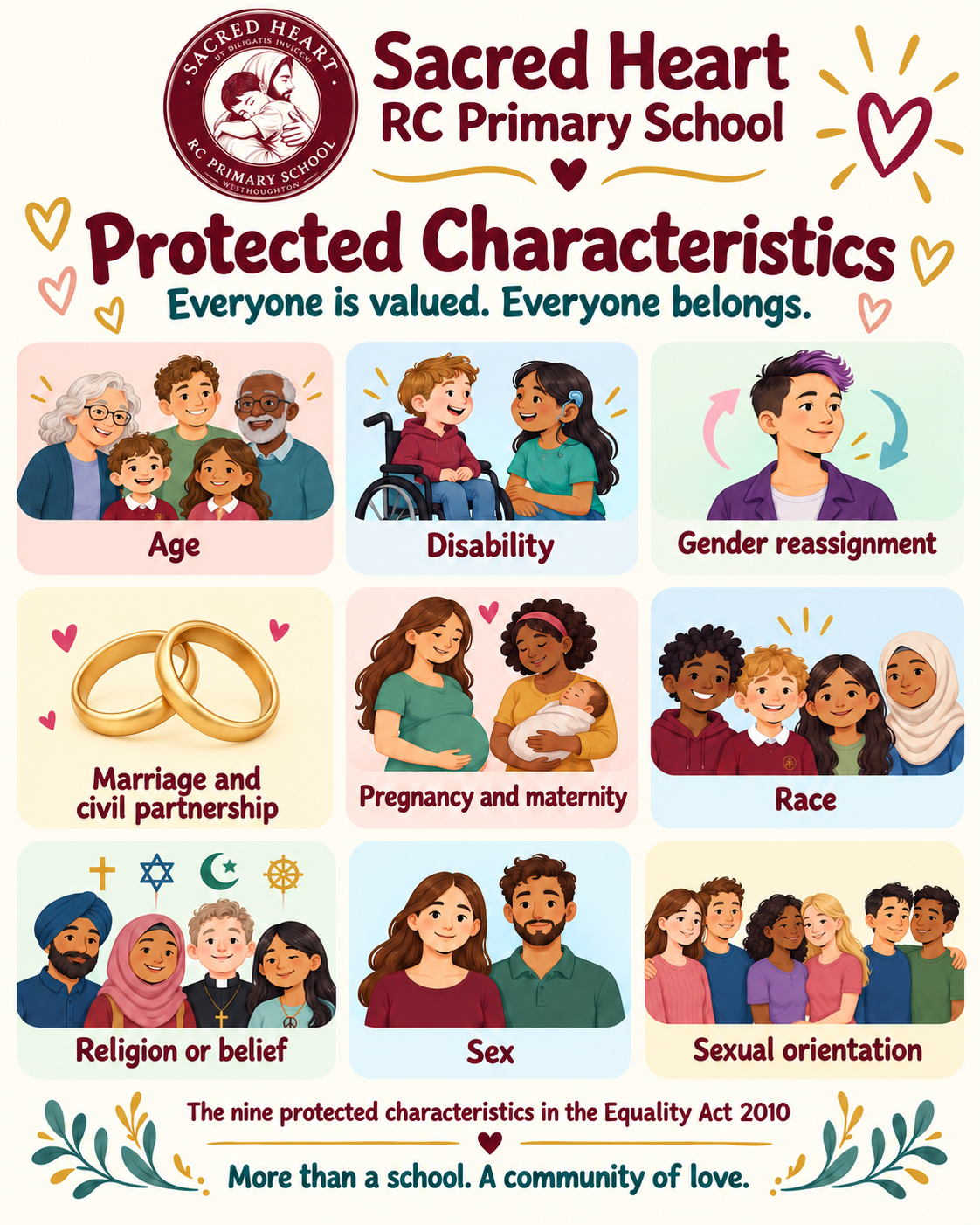
Protected Characteristics: dignity, respect and belonging
The Equality Act 2010 identifies nine protected characteristics. Its protections apply in contexts including education, employment and services, with different provisions applying in different circumstances.
At Sacred Heart, our starting point is the dignity of every person. We challenge discrimination and help children understand what fairness, inclusion and respect mean in everyday life.

Understanding the law in a school context
The nine characteristics explain the wider legal framework. Age and marriage and civil partnership are not protected characteristics under the Act’s school pupil provisions, although they apply in other contexts, including employment. Our commitment to dignity and respectful treatment extends to everyone.
Age
This concerns a person’s age or age group. Children learn to value people at different stages of life and listen to the experiences of other generations.
Disability
Disability can involve a physical or mental impairment with a substantial and long-term effect on everyday activities. Disabilities may be visible or non-visible.
We work with families to recognise barriers and consider reasonable adjustments. Disability and special educational needs can overlap, but are not identical.
Gender reassignment
This protection concerns people proposing to undergo, undergoing or having undergone a process of reassigning their sex. Medical treatment is not a requirement for this protection.
We challenge prejudice and handle individual circumstances sensitively, taking account of safeguarding, current guidance and children’s needs.
Marriage and civil partnership
This concerns being married or in a civil partnership. In England and Wales, opposite-sex and same-sex couples can marry or form a civil partnership.
Children should never feel less valued because of their parents’ relationships or family circumstances.
Pregnancy and maternity
The law provides protection relating to pregnancy and maternity, with specific rules depending on the setting.
We encourage consideration for pregnancy, new mothers and families caring for babies.
Race
Race includes colour, nationality and ethnic or national origins.
We value different languages, cultures and histories and challenge racism, racist language and racial stereotypes.
Religion or belief
This includes religion, qualifying philosophical beliefs and having no religion or belief.
We teach our Catholic faith clearly while respecting people of other faiths and those with no faith.
Sex
Sex is a protected characteristic concerning being male or female.
We promote fairness for girls and boys, women and men, and question stereotypes about interests, abilities, responsibilities and future opportunities.
Sexual orientation
This concerns orientation towards people of the opposite sex, the same sex or either sex, including heterosexual, gay, lesbian and bisexual people.
We challenge homophobic and biphobic language and bullying. Children and families should feel respected and included.
Everyone is valued. Everyone belongs.
A memorable way to remember the nine
A Diverse Group Makes Progress,
Respecting Rights, Sharing Support.
A · D · G · M · P · R · R · S · S
Each word’s first letter reminds us of one protected characteristic. The sentence is a memory aid; the full names are listed alongside it.
| Memory word | Protected characteristic |
|---|---|
| A | Age |
| Diverse | Disability |
| Group | Gender reassignment |
| Makes | Marriage and civil partnership |
| Progress | Pregnancy and maternity |
| Respecting | Race |
| Rights | Religion or belief |
| Sharing | Sex |
| Support | Sexual orientation |
Across our curriculum and Catholic mission
We follow Speak Truth to Power and Ten:Ten’s Life to the Full Plus schemes, which connect directly with dignity, rights, relationships, fairness and responsibility.
These principles also influence all relevant curriculum conversations. Teachers draw on them when discussing people, places, events, texts, beliefs and choices, connecting learning with how we treat others.
Speak Truth to Power
Children explore human rights and the courage of people who challenge injustice. They consider whose voices are heard, how prejudice affects people and how individual actions can contribute to change.
This supports democracy, individual liberty and mutual respect, helping children understand that their voices matter and that they have responsibilities towards other people.
Ten:Ten Life to the Full Plus
Our relationships and health education is rooted in a Catholic understanding of the human person: created, chosen and loved by God.
Children learn about friendship, kindness, personal boundaries, responsibility and safety. Learning is adapted to their age, understanding and needs, with questions addressed sensitively and information about the law taught factually.
Woven through school life
A story, historical event, religious encounter or discussion about fairness can help children consider different perspectives and recognise stereotypes.
Prayer, assemblies, pupil leadership, play and everyday relationships provide further opportunities to apply learning, explain opinions respectfully and challenge unkindness.
Rooted in our Catholic mission
Catholic Social Teaching calls us to solidarity, the common good and particular concern for people facing disadvantage. Love of neighbour involves noticing unfairness, listening and responding.
Fairness does not always mean identical treatment. Different support and reasonable adjustments can enable people to participate more fully.
Learning through relevant experiences
- Age and generations: learning from people at different stages of life.
- Disability and inclusion: understanding barriers and appreciating different achievements and contributions.
- Race and culture: exploring histories and experiences, challenging racism and learning through activities including Black History Month and Holocaust Memorial learning.
- Religion and belief: learning about Catholic faith and other religions through religious education, discussion and encounters.
- Families: recognising married and unmarried parents, single parents, same-sex parents, grandparents, adoptive parents, foster carers and other carers without making children feel their family is less valued.
- Fair opportunities: challenging assumptions about what girls and boys can achieve or enjoy.
- Respectful relationships: using considerate language, resolving disagreements and speaking up about unfairness.
The UK Primary Schools Hub for Human Rights Education
Robert & Ethel Kennedy Human Rights Centre UK
Sacred Heart RC Primary School is the UK primary schools hub for the Robert & Ethel Kennedy Human Rights Centre UK, previously known as RFK Human Rights UK.
Our role places human rights education at the heart of our school community and our work with other primary schools. It expresses our Catholic commitment to human dignity and our call to love one another.
Through Speak Truth to Power, children learn about fairness, human rights and the courage to challenge injustice. They discover that their actions can help build kinder and fairer communities.
Peacemakers, Caritas Ambassadors and other pupil leaders put this into practice by listening, including others, serving the community and speaking up when something is wrong.
Robert & Ethel Kennedy Human Rights Centre UK
Speaking up, finding support and removing barriers
Removing barriers
Fairness may involve different support so that people can participate. Reasonable adjustments can include communication, resources, routines or how activities are organised.
Please tell us if a disability, health condition or communication need affects access to learning, information, meetings or school events.
SEND and accessibility informationChallenging prejudice
Racist, sexist, homophobic, biphobic, transphobic, disability-related and religion-related abuse is unacceptable, including online.
Hurtful language is addressed even when described as a joke. Children and families do not need to wait for repeated incidents before asking for help.
Online safety informationOur public sector equality duty
In our decisions, we must have due regard to eliminating unlawful discrimination, advancing equality of opportunity and fostering good relations between people who share a relevant protected characteristic and those who do not.
We can draw on participation, attendance, progress, behaviour, reported incidents and the views of pupils and families to understand barriers and evaluate our response. Published information must protect personal privacy.
Equality information and objectives
Schools must update published equality information annually and equality objectives at least every four years.
Our Equality Objectives and Annual Update brings together our objectives and information about the work of the school to promote equality and inclusion.
Please contact the school office if you need a paper copy or an alternative accessible format.
Equality Objectives and Annual Update 2026
Read about our priorities and the action we take to help everyone participate, achieve and feel that they belong.
Download Equality Objectives and Annual Update 2026 — WordFurther information and guidance
- Department for Education — promoting British Values
- GOV.UK — discrimination and your rights
- Department for Education — Equality Act advice for schools
- Department for Education — preventing and tackling bullying
- Department for Education — relationships and health education
- Department for Education — school website publication requirements
Please contact the school office if you need help accessing this information.